
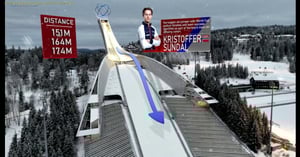
One freezing January morning in Oslo, we drove up to the Oslo Olympic Ski Jump to capture aerial footage with a DJI drone.
The plan was simple: film strong shots, bring the video into our camera tracking Pixotope Fly through SDI, and add AR graphics to show how quickly real locations can become broadcast-ready augmented scenes.
No studio. No tracking rig on site. Just a landmark, a drone, and a clean pipeline.
The Goal
This was not about pushing limits. It was about removing excuses.
AR is often seen as something that only works in controlled environments with big crews. We wanted to prove the opposite. Capture good footage on location, bring it back, feed it into Pixotope Fly like any other camera, and build compelling AR on top.
The setup was straightforward:
- A sub-250 g DJI Mini 4 Pro drone capturing cinematic aerials
- Footage recorded to SD card, then played back via a HyperDeck back at base.
- Pixotope Fly handling camera tracking and AR compositing with Pixotope Graphics
- A graphics package designed for large outdoor environments
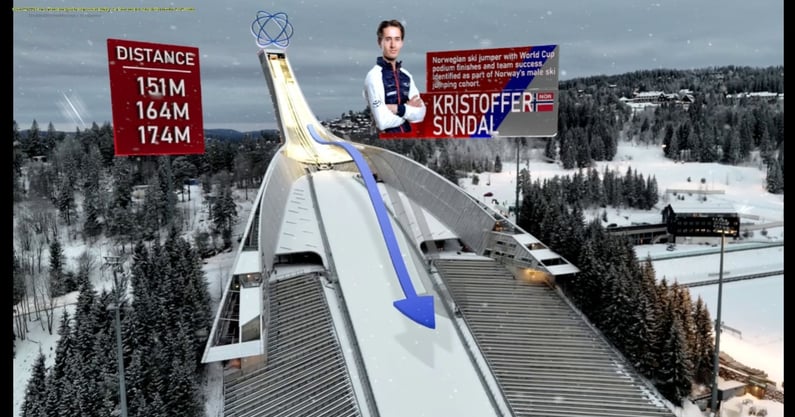
- Large 3D arrow along the ramp showing jump lengths
- Floating info panels over the skyline with dynamic data
- Object-locked logos that feel part of the structure
- Build show opens from real locations without major on-site setups
- Add sponsor or event graphics to landmark footage
- Prototype AR looks quickly using real world plate
This fits neatly into standard broadcast workflows.
Shooting the Plates
We focused on classic broadcast moves: slow push-ins, wide orbits, and high pullbacks to show scale. The priority was clean motion, strong parallax, and clear depth, all of which make tracking and AR integration work better.
The ski jump’s strong lines and clear structure gave virtual elements something solid to relate to. By the end, we had shots that already looked great on their own. AR should enhance good footage, not fix bad footage.
From Drone to AR
Back at the office, we played the drone footage into Pixotope through a HyperDeck over SDI, just like a live camera feed. Pixotope Fly recorded tracking in real time and embedded it into the video. Once tracking is embedded, you can iterate freely on AR graphics.The system works the same as live with the tracking embedded in a discrete audio channel.
The drone clip became a fully tracked 3D clip. The ski jump acted as the anchor, letting virtual elements sit on the ramp, float above it, or lock into the landscape and bring something extra special.
.png?width=965&height=559&name=image%20(35).png)
Building the Look
We designed bold, readable graphics for a large environment:
- Large 3D arrow along the ramp showing jump lengths
- Floating info panels over the skyline with dynamic data
- Object-locked logos that feel part of the structure
Everything was reusable and easy to reposition. No shot-by-shot rebuilds.
Why It Matters
You will not always be able to run full AR on location. Weather, access, and crew limits get in the way. But you can capture strong footage almost anywhere, then later feed it in over SDI and treat it like a live source.
That allows you to:
-
Build show opens from real locations without major on-site setups
-
Add sponsor or event graphics to landmark footage
-
Prototype AR looks quickly using real world plates
It does not replace live AR. It makes AR usable in more situations.
The hardest part was not the technology. It was pushing ourselves to go out in the freezing cold and pressing record. After that, the process was fast and repeatable.
If you are a Pixotope customer you can download this project from our Pixotope Downloads site to help you build out your own workflow. If you're interested in using Pixotope, then get in touch.

COMMENTS